C Programming Training In Coimbatore 100% Job Guarantee

  • Beginner & Advanced Level Classes.
  • 11402+ Students Trained, and 320+ Employing Clients.
  • Get Best Practices on Novice to Advanced Level Classes.
  • Delivered by 9+ Years of C Programming Certified Expert.
  • Lifetime Access to Student’s Portal, Study Materials, and Videos.

Explore the factors that draw more than 25,000 students to ACTE.

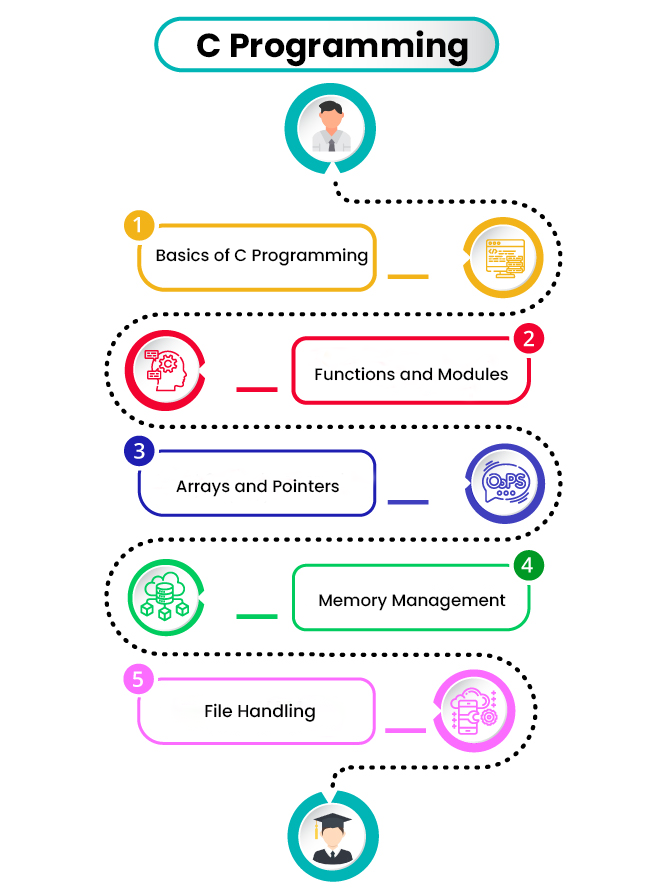
Curriculum in C Programming

Introduction
  • History of C and Purpose of Programming Languages
  • Basic Features of C
  • Layout of a C Program
  • Declarations
  • C Pre-processors
  • Exercises and Quizzes
  • Variables and Data Types
  • Characters, Integers and Floating Point Numbers
  • Naming Variables
  • Constants
  • Exercises and Quizzes

  • Operators
  • Purpose and Various Types of Operators
  • Expressions and Expression Handling
  • Integer Vs. Floating Arithmetic
  • Assignment Operators
  • Exercises and Quizzes

  • Control Statements
  • If and else if Statements
  • Relational, Logical and Equality Operators
  • The! Operator
  • Value of an Expression
  • Condition Expressions
  • Switch Statements
  • Exercises and Quizzes

  • Loops
  • For, While and Do- while loops
  • Exercises and Quizzes
  • Functions
  • Declaration of Functions
  • Returning Values
  • Variables and scope
  • Understanding the stack
  • Exercises and Quizzes
  • Arrays
  • Array Dimensions
  • An array as an argument to a function
  • Two Dimension arrays
  • String Arrays
  • Exercises and Quizzes

  • Pointers
  • Fundamental Concepts
  • Pointer Operators and Operations
  • Changing an argument with a function call
  • Pointer Arithmetic
  • Array Traversal
  • String Functions With Pointers
  • Exercises and Quizzes
  • Introduction to Structures
  • Fundamental Concepts
  • Describing a Structure
  • Creating a Structure
  • Operations on Structures
  • Functions Returning Structures
  • Additional Concepts
  • Exercises and Quizzes

  • Curriculum in C Programming

    C Programming Is Preferred by Over 35% of Developers. C Programming is the most widely used and in-demand programming language in the IT industry.

    • History of C and Purpose of Programming Languages
    • Basic Features of C
    • Layout of a C Program
    • Declarations
    • C Pre-processors
    • Exercises and Quizzes
    • Characters, Integers and Floating Point Numbers
    • Naming Variables
    • Constants
    • Exercises and Quizzes

    • Purpose and Various Types of Operators
    • Expressions and Expression Handling
    • Integer Vs. Floating Arithmetic
    • Assignment Operators
    • Exercises and Quizzes
    • If and else if Statements
    • Relational, Logical and Equality Operators
    • The! Operator
    • Value of an Expression
    • Condition Expressions
    • Switch Statements
    • Exercises and Quizzes
    • For, While and Do- while loops
    • Exercises and Quizzes
    • Declaration of Functions
    • Returning Values
    • Variables and scope
    • Understanding the stack
    • Exercises and Quizzes
    • Array Dimensions
    • An array as an argument to a function
    • Two Dimension arrays
    • String Arrays
    • Exercises and Quizzes
    • Fundamental Concepts
    • Pointer Operators and Operations
    • Changing an argument with a function call
    • Pointer Arithmetic
    • Array Traversal
    • String Functions With Pointers
    • Exercises and Quizzes
    • Fundamental Concepts
    • Describing a Structure
    • Creating a Structure
    • Operations on Structures
    • Functions Returning Structures
    • Additional Concepts
    • Exercises and Quizzes

    C Programming Training Projects

    Develop Your C Programming Skills With Useful and Interesting Projects.


    Simple Contact Manager

    Develop a program to manage contacts with features such as adding, deleting, and searching for contacts.


    Basic Text Editor

    Build a simple text editor that allows users to create, edit, save, and load text files.


    Currency Converter

    Create a program that converts between different currencies based on current exchange rates.


    Library Management System

    To handle library resources like books, borrowers, and transactions, develop a software.


    Web Server

    Develop a simple HTTP server that can handle basic web requests like GET and POST.


    Basic Database Management System

    Build a program that simulates a simple relational database management system with functionalities like creating tables, inserting records, and querying data.


    Compiler Optimization Techniques

    Research and implement advanced compiler optimization techniques to improve the performance of compiled code.


    Artificial Intelligence Game

    Develop a game with AI opponents that can learn and adapt to the player's strategies over time.


    Blockchain Implementation

    Implement a simplified version of a blockchain system with features like block creation, transaction validation, and consensus mechanisms.

    Key Highlights

    Our Instructor

    Get advice from specialists who have certifications and are currently working.

    C Programming Training Overview

    C programming is a foundational and versatile language that has been widely used since its creation in the early 1970s. Renowned for its efficiency, C provides programmers with direct access to system resources and allows for low-level manipulation, making it ideal for tasks requiring high performance and control over hardware. Its simplicity, portability, and close-to-the-hardware nature have ensured its enduring popularity in system software development, embedded systems programming, and areas where performance is critical. C's influence extends to numerous fields, including operating system development, device driver programming, game development, and more. Its syntax and concepts have served as the basis for many other programming languages, making it essential knowledge for aspiring programmers. Despite the emergence of newer languages, C remains a cornerstone of computer science education and continues to play a significant role in the software development landscape.

    Additional Information

    C Programming Programmer’s Potential Career Paths

    C programming offers programmers a wide range of potential career paths, spanning various industries and roles. Here are some potential career paths for C programmers:

    • Systems software developers design and develop operating systems, device drivers, compilers, and other low-level software that enables computers and embedded systems to function. They require a deep understanding of C programming, computer architecture, and system-level programming.
    • Embedded systems engineers design and develop software for embedded systems, which are specialized computing devices designed for specific tasks. They work in industries such as automotive, aerospace, consumer electronics, and industrial automation, creating firmware and software for microcontrollers, sensors, and other embedded devices.
    • While higher-level languages are often used for application development, there are still opportunities for C programmers to work on performance-critical applications such as video games, high-frequency trading systems, and real-time applications. Application developers may work in industries such as gaming, finance, telecommunications, and scientific computing.
    • Compiler engineers design and develop compilers, interpreters, and other language processing tools. They require expertise in compiler theory, programming languages, and low-level optimization techniques. Compiler engineers may work for technology companies, research institutions, or compiler tool vendors.

    What Are the Requirements for an C Programming Training Course?

    The requirements for a C programming training course can vary depending on the target audience and the depth of the course content.

    • Participants should have a basic understanding of how to use a computer, including tasks such as navigating the operating system, managing files, and using text editors or integrated development environments (IDEs).
    • While not strictly necessary, familiarity with fundamental programming concepts such as variables, data types, control structures (e.g., loops, conditionals), functions, and basic algorithms can be beneficial.
    • Some familiarity with mathematics, particularly concepts like arithmetic operations, logic, and basic algebra, can aid in understanding programming concepts and problem-solving.
    • Many introductory C programming courses are designed for individuals with little to no prior programming experience. These courses often start with the basics and gradually build up to more advanced topics.

    Reasons to Consider Enrolling in C Programming Training

    Enrolling in a C programming training course can offer numerous benefits for individuals interested in computer programming and software development.

    • C programming is considered the foundation of modern programming languages. Learning C provides a solid understanding of fundamental programming concepts like variables, data types, control structures, and functions, which are applicable across a wide range of programming languages and technologies.
    • C programming is versatile and widely used across various domains, including system software development, embedded systems programming, application development, and more. Mastering C opens up opportunities in diverse industries and roles, making it a valuable skillset for aspiring programmers.
    • C is renowned for its efficiency and performance, making it ideal for programming tasks where speed and resource utilization are critical. Understanding C allows developers to write code that executes quickly and optimally, making it suitable for performance-critical applications like real-time systems, games, and high-frequency trading platforms.
    • C provides low-level access to system resources and hardware, allowing developers to understand and control the underlying mechanisms of computers and devices. This level of understanding is valuable for tasks such as operating system development, device driver programming, and embedded systems development.

    Techniques and Trends in C Programming Development

    In C programming development, several techniques and trends are shaping the way software is designed, developed, and maintained. Here are some prominent ones:

    • While C is an old language, modern C programming practices emphasize readability, maintainability, and portability. Techniques such as modular programming, code reuse, and adherence to coding standards like MISRA C help developers write cleaner and more maintainable code.
    • Efficient memory management is crucial in C programming due to its direct access to memory. Techniques such as dynamic memory allocation (malloc, calloc, realloc) and manual memory deallocation (free) are commonly used. However, to avoid memory leaks and segmentation faults, modern C programming encourages the use of safer alternatives like smart pointers and automated memory management techniques.
    • With the increasing prevalence of multicore processors and parallel computing, concurrency and multithreading have become important in C programming. Techniques such as pthreads (POSIX threads) and synchronization primitives (mutexes, semaphores) are used to develop multithreaded applications. Additionally, libraries like OpenMP provide directives for parallelizing loops and other computations.
    • Static code analysis tools help identify potential bugs, security vulnerabilities, and coding standard violations in C code. Tools like Coverity, PVS-Studio, and clang-tidy are commonly used to perform static code analysis and ensure code quality. Additionally, unit testing frameworks such as CUnit and Unity facilitate automated testing of C code, helping detect bugs early in the development process.
    Show More

    Enter details. Get MNC calls!

    C Programming Training Objectives

    To obtain an authorized C programming certification, you typically need to enroll in a certification program offered by a recognized certification provider or organization. These programs often include training courses, study materials, and exams designed to assess your proficiency in C programming. Upon successful completion of the program and passing the certification exam, you will receive a C programming certification credential.

  • Validation of your skills and expertise in C programming, enhancing your credibility and marketability
  • Increased job prospects and career advancement opportunities, especially in roles requiring C programming proficiency
  • Recognition by employers and industry professionals, demonstrating your commitment to learning and professional development
  • Opportunities for networking and professional growth within the C programming community
  • Higher earning potential and salary opportunities compared to non-certified professionals
  • C programming training certification is significant as it demonstrates your mastery of C programming concepts, techniques, and best practices. It validates your ability to write efficient, reliable, and maintainable code in the C programming language, which is highly valued by employers across various industries.

  • Proficiency in C programming language syntax and semantics
  • Knowledge of memory management techniques, including dynamic memory allocation and deallocation
  • Familiarity with data structures and algorithms
  • Ability to develop efficient and reliable software applications using C programming language
  • Debugging and troubleshooting skills to identify and fix errors in C code
  • Your earning potential and pay prospects may rise if you acquire a certification in C programming. Because certificates attest to a person's abilities and knowledge in a particular industry, certified professionals sometimes fetch better compensation than their non-certified peers. However, income gains may vary based on factors such as region, sector, experience level, and demand for C programming abilities in the employment market.

  • Systems Software Developer
  • Embedded Systems Engineer
  • Firmware Engineer
  • Real-Time Systems Developer
  • Network Programmer
  • Security Engineer
  • Game Developer
  • Device Driver Developer
  • Show More

    Industry Statistics

    Jobs / Month

    248

    Avg. Salary

    ₹ 12,55,200

    Job Roles

    Junior C Programmer

    Firmware Developer

    Application Developer

    Software Engineer

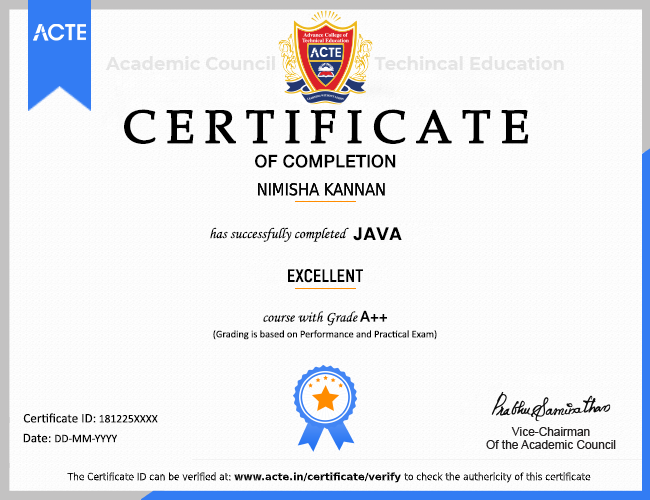
    C Programming Certification

    Certificate
    GET A SAMPLE CERTIFICATE
  • Validation of skills
  • Career advancement
  • Higher earning potential
  • Industry recognition
  • Professional development
  • Yes, there are several C Programming certifications available from various certification providers. These certifications cater to different skill levels and areas of specialization within C programming, such as foundational knowledge, advanced concepts, embedded systems development, and real-time programming.

    While having a C Programming certification can enhance your job prospects and increase your chances of securing employment, it does not guarantee you a job. However, certification can make you a more competitive candidate in the job market and improve your chances of landing interviews and job offers, especially for roles requiring C programming skills.

    Yes, you can pursue multiple C Programming course certifications to broaden your skill set and enhance your credentials. Pursuing certifications in related areas or specialized domains within C programming can further improve your career prospects and expand your job opportunities.

  • Systems Software Developer
  • Embedded Systems Engineer
  • Firmware Engineer
  • Real-Time Systems Developer
  • Network Programmer
  • Security Engineer
  • Game Developer
  • Device Driver Developer
  • Yes, many certification providers offer online versions of the C Programming certification exam. These online exams allow candidates to take the test remotely from their home or office, providing convenience and flexibility in scheduling the exam.

    While real-world experience can be beneficial for preparing for a C Programming certification exam, it is not always required. However, practical experience with C programming can help reinforce your understanding of the concepts covered in the exam and improve your performance.

    The worth of earning an PLACEMENT7 C Programming Certification depends on various factors such as your career goals, industry demand, and the reputation of the certification provider. PLACEMENT7 is a reputed training institute that offers C Programming courses and certifications. Obtaining a certification from PLACEMENT7 can enhance your skills and credibility in the job market, potentially leading to better job opportunities and career advancement. However, it's essential to evaluate the cost, time, and benefits of the certification program to determine if it aligns with your career objectives.

    Show More

    The Preferred Partner for 100+ Organizations' Hiring

    Learn from the certified and real time working professionals.

    • Over 100 firms that are looking for top talent for their open positions have come to rely on PLACEMENT7 as their go-to partner.

    • Businesses have confidence in our ability to match them with the best individuals because of our considerable expertise and proven track record of success.

    • In this section, we'll examine the primary elements influencing this trust and examine how our constant commitment to excellence regularly results in remarkable results for our clients.

    Corporate Clients

    C Programming Course Duration and Fees

    Level Course Duration Fees Structure
    Basic 1 - 1.5 Months ₹7,000 - ₹9,000
    Advanced 1.5 - 2 Months ₹7,000 - ₹10,000

    Job Opportunities in C Programming

    C Programming is preferred by more than 35% of developers. The most widely used and in-demand programming language in the tech industry is C Programming.

    Salary In C Programming
    Reach Our Placement Officer

    You can Work as a

    Software EngineerGame DeveloperSecurity Software EngineerDatabase ProgrammerWeb Server DeveloperTelecom Software EngineerAudio Software Engineer

    Upcoming In-Demand Jobs

    Junior C ProgrammerEmbedded Software EngineerFirmware DeveloperApplication DeveloperSystems Software Engineer

    Student Testimonials

    100% Placement

    7000+ Placed Student

    600+ Hiring Partners

    5.5 LPA Average Salary

    Recently Placed Students

    C Programming Training FAQ's

    Boost Your Coding Ability: Essential C Programming Training for Novices and Experienced

    C Programming is a procedural programming language developed by Dennis Ritchie in the early 1970s. It is widely used for system programming, embedded programming, and application development due to its efficiency, portability, and flexibility. C is known for its low-level access to memory, which makes it suitable for developing operating systems, device drivers, and other software that requires direct hardware interaction.

    C Programming training involves learning the fundamentals and advanced concepts of the C programming language through educational programs, courses, or workshops. These training programs typically cover topics such as syntax, data types, control structures, functions, pointers, memory management, file handling, and more. C Programming training aims to equip participants with the knowledge and skills needed to develop efficient and reliable software solutions using C.

  • Career opportunities
  • Foundational knowledge
  • Efficiency and performance
  • Flexibility and portability
  • Introduction to C programming
  • Data types and variables
  • Operators and expressions
  • Control structures (if-else, switch, loops)
  • Functions and recursion
  • Arrays and strings
  • Pointers and dynamic memory allocation
  • Structures and unions
  • File handling
  • Preprocessor directives
  • Advanced topics such as memory management, bitwise operations, and multi-file programming.
  • The duration of C Programming training can vary depending on the depth of the curriculum, the pace of learning, and the format of the training program. Some introductory courses may be completed in a few weeks, while more comprehensive training programs covering advanced topics may take several months to complete. Additionally, self-paced online courses allow learners to progress at their own speed, so the time to complete the training can vary from individual to individual.

  • Review the exam objectives
  • Study the material
  • Practice coding
  • Take practice exams
  • Seek help if needed
  • Review and revise
  • Show More
  • Basic understanding of computer science fundamentals such as algorithms, data structures, and problem-solving.
  • Familiarity with any programming language, although prior experience with C is not always required.
  • Comfort with using a computer and basic software applications.
  • Motivation and willingness to learn.
  • Stay engaged by participating in forums, discussion groups, or online communities related to C programming.
  • Take breaks when needed to prevent burnout and maintain a healthy balance between learning and other activities.
  • Remind yourself of the reasons why you wanted to learn C programming in the first place and visualize your success.
  • Actively engage with the material by taking notes, asking questions, and practicing coding exercises.
  • Break down complex topics into smaller, more digestible chunks and focus on mastering one concept at a time.
  • Use multiple learning resources such as textbooks, online tutorials, videos, and coding challenges to reinforce your understanding.
  • Seek help from instructors, mentors, or online forums if you encounter difficulties or have questions.
  • Apply what you learn by working on real-world projects or coding challenges to solidify your skills and build a portfolio.
  • Review and revise regularly to reinforce your learning and ensure retention of important concepts.
  • Yes, it is feasible to acquire C Programming skills through online learning without any prior programming experience. Many online courses cater to beginners and start with the basics, providing step-by-step instruction and hands-on exercises to build foundational knowledge and skills. With dedication, practice, and perseverance, individuals can learn C programming effectively through online courses, regardless of their prior experience.

    Many online C Programming courses offer certificates upon course completion. These certificates can serve as proof of your accomplishment and may be useful for job applications, career advancement, or simply as a personal achievement. However, not all courses provide certificates, so it's important to check the course details or contact the course provider to confirm certificate availability.

    Yes, online C Programming training can be effective for beginners. Many online courses are designed specifically for beginners and provide comprehensive instruction, interactive exercises, and support to help learners build a strong foundation in C programming. The self-paced nature of online learning allows beginners to progress at their own speed and revisit concepts as needed, making it accessible and effective for learners of all levels.

    Show More
  • C Programming is widely used in software development, system programming, and embedded systems, making it crucial for employees working in these domains.
  • Corporate training ensures that employees have the necessary skills to develop efficient and reliable software solutions using C, contributing to the organization's productivity and competitiveness.
  • By investing in C Programming corporate training, organizations can address skill gaps, enhance employee performance, and drive innovation in their products and services.
  • Equipping employees with the knowledge and skills needed to develop software solutions using the C programming language.
  • Addressing specific skill gaps and challenges within the organization related to C programming.
  • Enhancing employee productivity, efficiency, and performance in software development projects.
  • Aligning employee skills with the organization's strategic objectives and business goals.
  • Customizing the training curriculum to focus on specific topics or skills relevant to the organization's industry, projects, or technology stack.
  • Incorporating real-world examples, case studies, and projects that reflect the organization's domain and challenges.
  • Adapting the training delivery method, duration, and schedule to accommodate the organization's preferences and constraints.
  • Providing hands-on exercises, workshops, or simulations tailored to the organization's requirements and goals.
  • Offering flexible training options such as onsite training, virtual instructor-led training (VILT), or self-paced online courses to accommodate diverse learning preferences and work schedules.
  • The duration of a C Programming corporate training program can vary depending on factors such as the depth of the curriculum, the level of customization, and the delivery method. Typically, corporate training programs range from a few days to several weeks, with intensive boot camps or comprehensive courses lasting longer. The duration of the training program can be adaptable to your company's timetable by scheduling sessions at convenient times, offering flexible training formats, or customizing the training duration to fit your organization's needs.

  • Extensive experience and expertise in C programming, including practical industry experience in software development, system programming, or related fields.
  • Strong communication and teaching skills to effectively convey complex technical concepts and facilitate learning among participants.
  • Relevant educational qualifications such as degrees in computer science, software engineering, or related disciplines.
  • Certifications or credentials demonstrating proficiency in C programming or related technologies may also be beneficial.
  • Introduction to C programming language
  • Data types, variables, and operators
  • Control structures (if-else, switch, loops
  • )
  • Functions and recursion
  • Arrays, strings, and pointers
  • Memory management and dynamic allocation
  • File handling and input/output operations
  • Structured programming techniques
  • Error handling and debugging strategies
  • Advanced topics such as data structures, algorithms, and optimization techniques may also be included depending on the organization's requirements.
  • Show More